
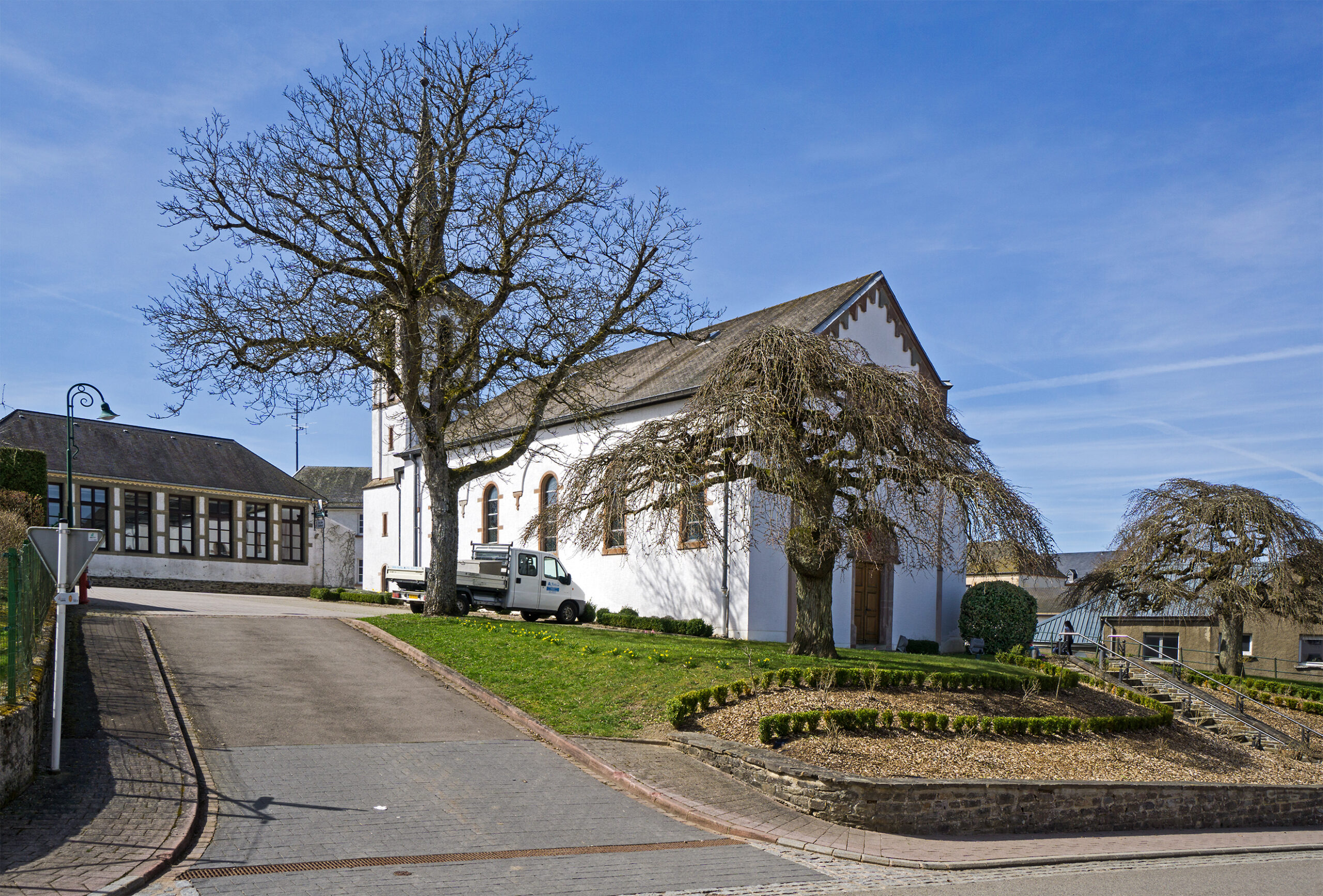
Baschleiden, known as “Baschelt” in Luxembourgish, is a town in the municipality of Boulaide. Its name already hints at its landscape: the ending “-schleiden” comes from the Middle High German sleide, meaning a sloping area or skein. Until 1828, Baschleiden belonged to the municipality of Meecher, before becoming part of Boulaide as it is today.
Despite its modest size, the town has long played a practical role in the region. Daily mail delivery began in 1850, serving not only Baschleiden but 24 surrounding villages, turning the town into a small but important hub of everyday life.
Churches and community life through the centuries
Religion and community have shaped Baschleiden’s built landscape for centuries. The Old Church of St. Willibrord, dating from the 12th or 13th century, is a Romanesque structure with rounded arches and thick walls. For a long time, it served as both a historical landmark and a community center. Today, it attracts visitors interested in Luxembourg’s medieval past, while preservation efforts protect its historical value.
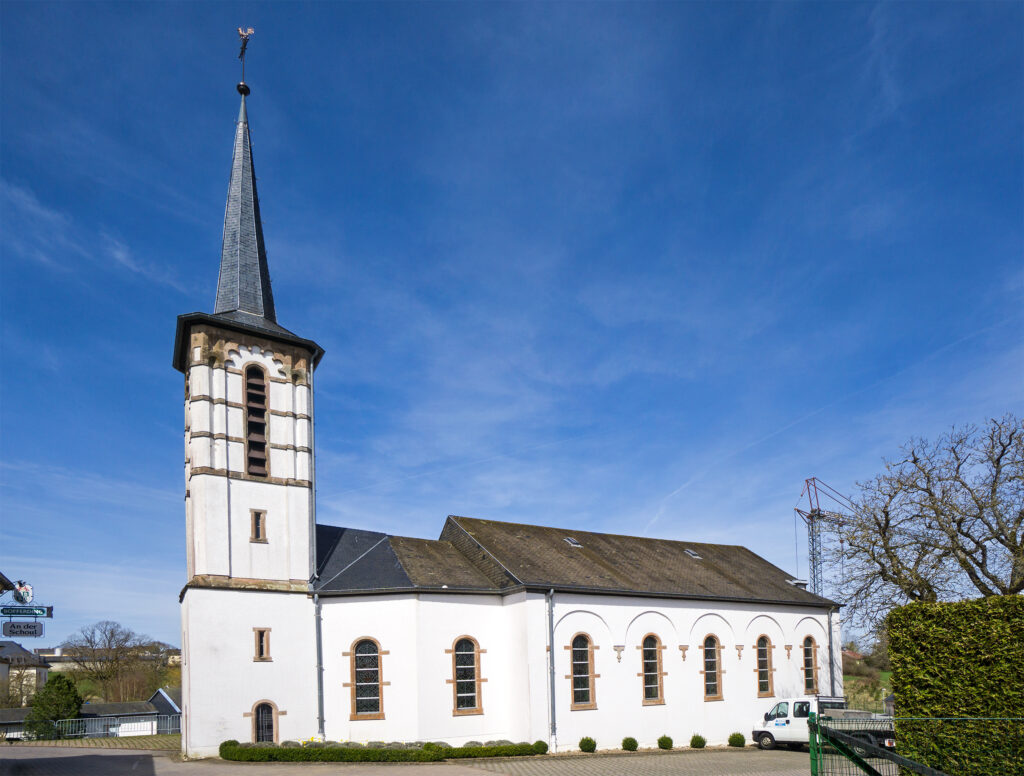
The new St. Willibrord Church was built between 1872 and 1875. Its foundation stone, likely laid between 1837 and 1843, supports the imposing bell tower that now defines the village skyline.
Just behind the church stands another reminder of everyday history. The building now used as the town hall was once the village school, constructed in 1860, reflecting Baschleiden’s long-standing role as a place of learning and local administration.
People, journeys, and stories beyond the village
Baschleiden is the birthplace of Charles-Gérard Eyschen (1800–1859), who became Director General of Justice, giving the town a notable place in Luxembourg’s political and legal history.
Its story also stretches far beyond Europe. On an immigrant ship traveling from Antwerp to New York, bound for Wisconsin, there were two families from Baschleiden, both fathers registered as farmers. One of them, Hans-Peter D., later returned to Baschleiden to spend his retirement years, sharing stories of his adventures abroad.
Another long-running chapter connects the town to the United States. The descendants of Edouard Denell, born in Baschleiden in 1884 and emigrated to Chicago in 1909, searched for their Luxembourg relatives for more than 80 years, keeping alive a link between generations and continents.
Landscape, landmarks, and quiet paths
Baschleiden lies close to the Tempelskamp viewpoint, which offers a magnificent view of the Upper Sûre Lake. From here, the natural setting becomes part of the town’s identity.
Hiking is an important way to experience the area. Several scenic trails start in or pass through Baschleiden, including the local hiking trail BL5 and the Baschleiden Auto-pedestre trail, inviting visitors to explore the surrounding countryside at a slower pace.
One natural monument stands out in particular. An old beech tree belonging to Baschleiden grows at a place called “Hoschtig”. In 1984, it was officially added to the list of national monuments, recognizing its cultural and natural significance.
Together, these layers of history, migration, landscape, and community life give Baschleiden a distinct depth, shaped by everyday life, long journeys, and enduring landmarks. Each story, whether rooted in the village itself or carried across borders, fits into a broader historical flow that continues to define the character of the place.