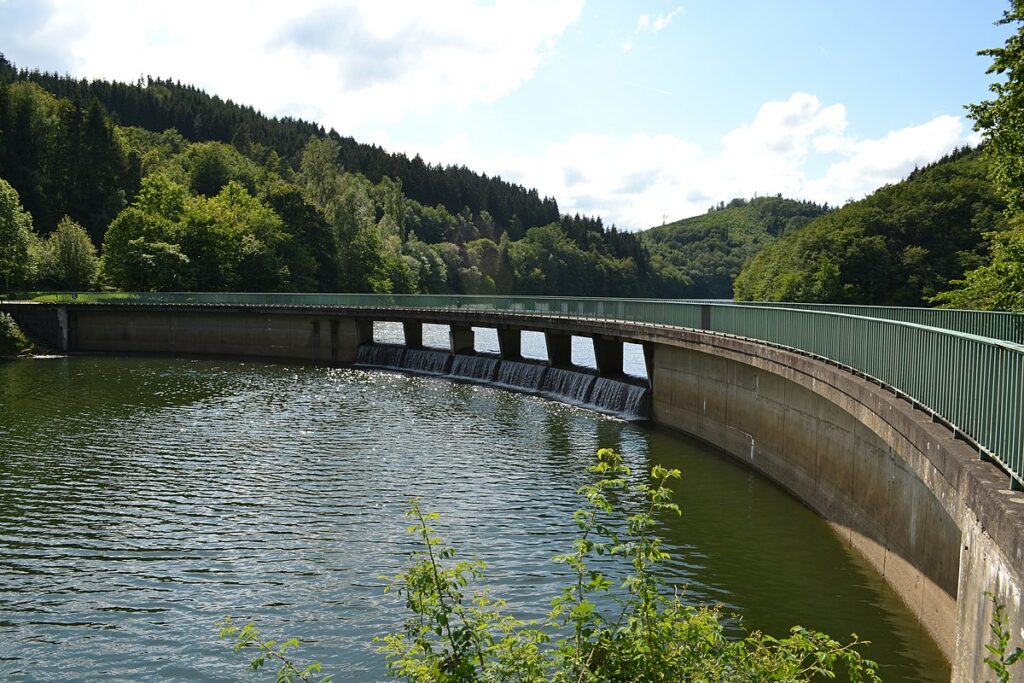
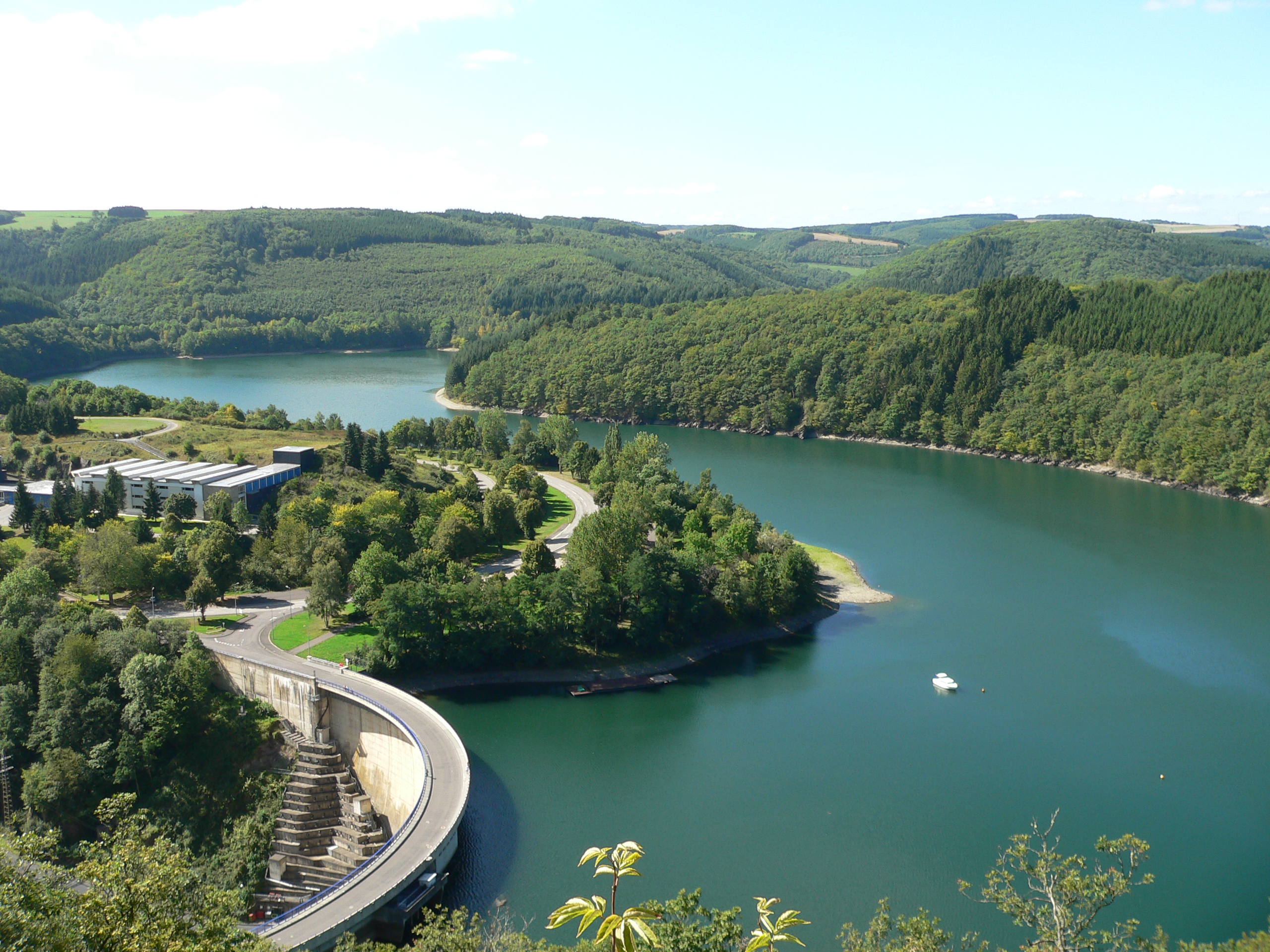
Upper Sure Lake is a reservoir located within the 230 km² Naturpark Öewersauer, which spans six municipalities and is home to approximately 15,500 inhabitants. The lake was created in 1961 with the construction of a 47-meter-high dam, which required the relocation of some village residents. Remains of the submerged village are still accessible to experienced divers.
Covering an average surface area of 3.8 km², or 0.15% of Luxembourg’s total land area, the lake is the country’s largest body of water. It supplies drinking water to around 70% of households and also functions as a hydroelectric reservoir. Protected areas of the lake, located about 5 km from the main dam, are closed to entry to ensure water quality.
The lake supports a range of recreational activities. Water sports such as swimming, canoeing, diving, windsurfing, sailing, and solar boating are common.
A solar-powered boat provides guided tours of the lake, including the “Amphibious” tour, which combines an 8 km hike along the left bank with a solar boat excursion past the Hellekessel and across the dam wall. The valley surrounding the reservoir has been designated a Ramsar wetland since 2004, reflecting its ecological importance.
La Sûre
La Sûre is Luxembourg’s longest river, stretching 173 kilometers from its source in the Belgian Ardennes to its confluence with the Moselle River near Trier. Along its course, it forms natural borders with Belgium for approximately 13 km and with Germany for around 50 km, passing through the Müllerthal region and flowing into the Upper Sure Lake. Its tributaries include the Syrbach, Wiltz, Alzette, Blees, Ernz Blanche, Our, Gaybach, Ernz Noire, and Prüm.
Conservation measures have been implemented along the river through initiatives such as the River Contract, aimed at maintaining biodiversity and controlling pollution and invasive species. Projects like “Loscht op Natur” provide educational information on plants and animals in the region, and measures such as late mowing help preserve natural habitats.
Naturpark Öewersauer monitors endangered species, protected areas, and invasive species along the river to support long-term ecological preservation.
Electricity in Boulaide
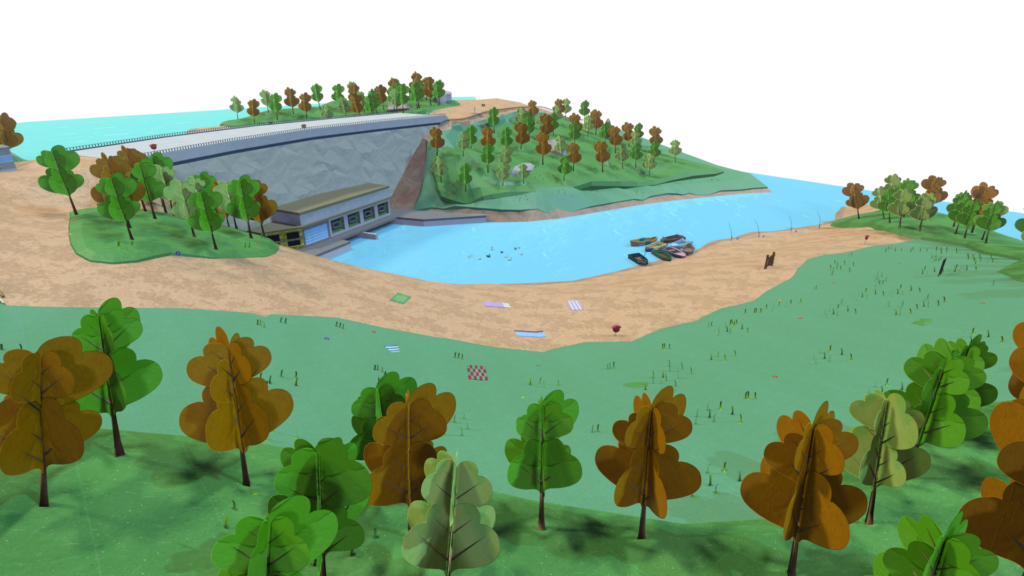
Boulaide was one of the early villages in Luxembourg to adopt electricity. In 1911, Jean-Baptiste Meyers and Nicolas Tock installed a steam engine in Tock’s shed to generate electricity locally. This system was later supplemented in 1920 with a diesel engine. After Tock’s death in 1924, the village faced challenges in electricity production. Nic Theisen advanced the electricity infrastructure by acquiring a second-hand diesel engine with a generator, and by 1932 most houses in Boulaide were connected to the electricity grid.
Water power from the Sûre River was also used to generate electricity at the Holsber site and in several mills, including the Bauschelter Millen. In 1937, CEGEDEL took over the electricity supply in Boulaide, marking the modernization and expansion of the local electricity network. During this period, the Electro-Federation organized educational events on the use of electrical appliances, while local residents such as Ferdy Haas and Albert Haas contributed to installing switches, sockets, and meters in homes and businesses.